
Garage door safety sensors or misaligned travel limits commonly cause a door to reverse two inches from the floor instead of closing fully. Close-limit settings, worn rollers, or track obstructions trigger the opener’s auto-reverse feature. Precision Garage Door Service technicians diagnose limit-switch and sensor issues, restore proper closing function, and prevent repeated reversal problems.
Why Does My Garage Door Reverse Before Hitting the Floor?
A garage door that touches down and then pops right back up isn’t broken in a random, unpredictable way. That sudden reversal is actually a built-in safety feature, engineered specifically to prevent injury before it happens. When a garage door reverses unexpectedly, the opener is doing exactly what it was designed to do: stop and protect.
The safety mechanism prevents injury or property damage, but it doesn’t always trigger for the right reasons. Sometimes the system fires even when nothing is actually in the door’s path. That false trigger usually points to one of three underlying issues:
- Misaligned or dirty photo-eye sensors
- Worn rollers, hinges, or track hardware
- Incorrect force or limit settings on the opener
What causes garage door sensor problems specifically?
Garage door sensor problems happen when the two small sensors near the bottom of the track fall out of alignment or get blocked by dust, spider webs, or clutter. Once they can’t “see” each other properly, the opener assumes something is blocking the door and reverses it as a precaution. Homeowners often notice this pattern right when a garage door won’t close fully, stopping a few inches short every time.
Is it safe to fix this myself?
Adjusting sensors, springs, or opener settings without proper training carries real risk, mainly because garage door components are heavier than they appear. Installing or tweaking these parts incorrectly can cause the door to collapse, putting anyone standing nearby in serious danger. Given those stakes, homeowners facing repeated reversals are better served scheduling a professional inspection than troubleshooting blind.
Why Does the Door Stop Inches From Closing?
Mechanical tension, not a mysterious glitch, usually explains a door that halts a few inches above the concrete. Many homeowners report a door that gets within about two inches of the ground before the garage door reverses. It climbs back up rather than finishing its cycle. This pattern often points to a spring system fighting against the opener’s programmed limits instead of working with them.
The behavior rarely shows up every single time, which makes it especially confusing. Some homeowners see the garage door won’t close issue roughly 80 to 90 percent of attempts. The door occasionally completes its trip to the floor exactly as designed. That inconsistency is a clue: a fully broken sensor or motor tends to fail the same way every time. A tension problem shows up unevenly because spring force shifts slightly with each cycle.
What role do springs play in this problem?
Torsion springs counterbalance the door’s weight. When that tension drifts out of calibration, the opener senses resistance near the floor and reverses as a protective response. A technician may find that springs need periodic adjustment to keep the reversal from recurring. Left unaddressed, spring tension issues compound over time rather than resolving on their own.
Is a failing spring dangerous to ignore?
Yes. A torsion spring under high tension can snap without warning. Anyone standing near the door at that moment faces a real risk of serious injury. This safety concern is a major reason spring-related reversing problems deserve prompt attention, not a wait-and-see approach. Homeowners noticing consistent stopping points, paired with any of these signs, should treat the issue as a priority:
- Door stops at the same spot on nearly every cycle
- Visible gap or slack in the spring coil
- Louder-than-usual creaking or grinding during descent
Why Does the Door Travel Only Partway Then Reverse?
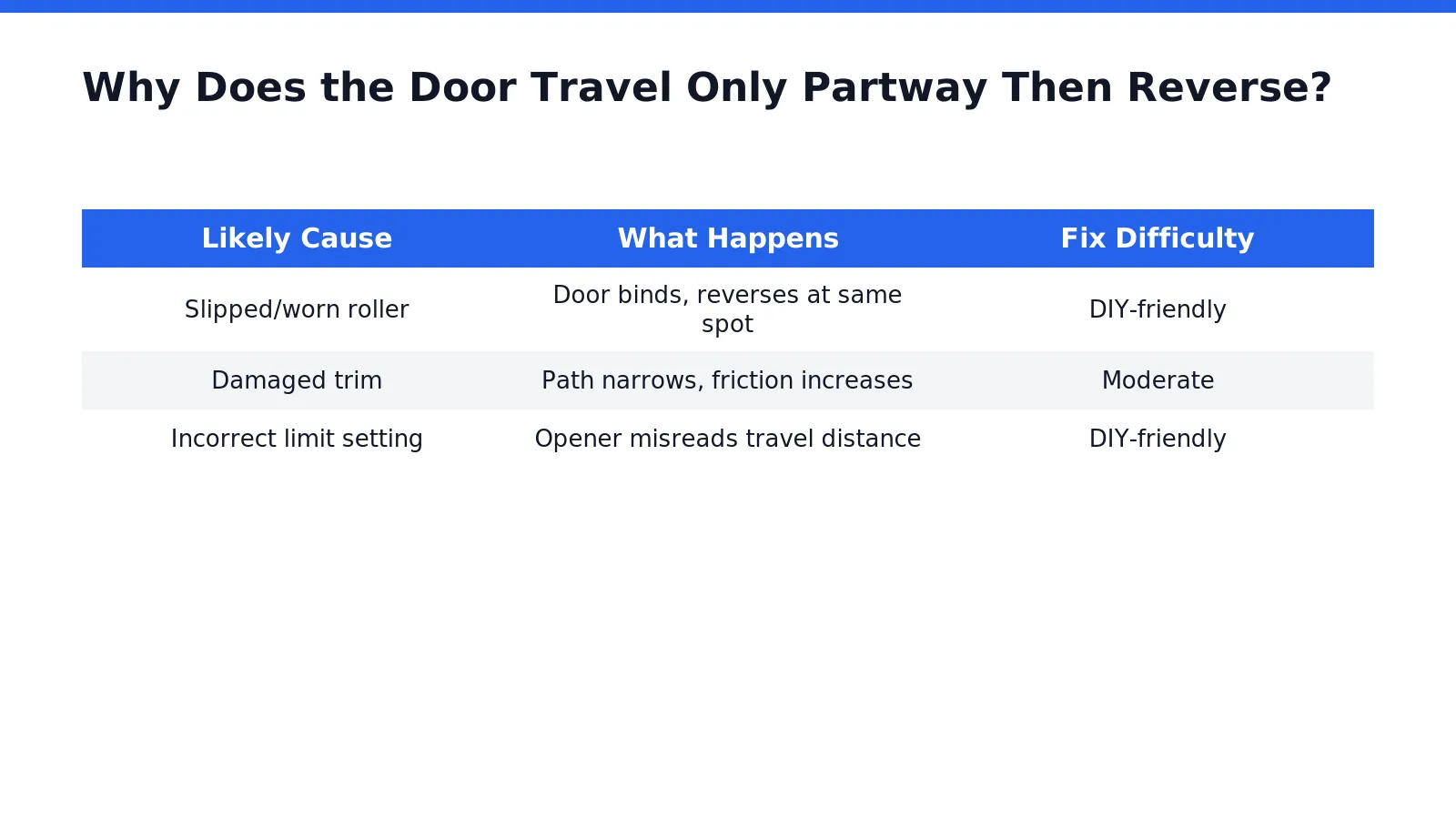
Worn or damaged rollers, sometimes called the door’s wheels, cause most cases of a door that starts closing, binds, then reverses before reaching the floor. When a roller slips off its track, the door meets resistance partway down, and the opener’s safety system reads that resistance as an obstruction. The result is a garage door reversal pattern that repeats at nearly the same spot every time.
Deteriorated trim contributes to the same problem. Garage door trim keeps the door running smoothly along its tracks while shielding it from moisture that causes swelling, warping, and eventual binding. Once trim breaks down, the door’s path narrows, and rollers catch more easily during the final feet of travel.
What should be checked first when a door won’t close all the way?
Homeowners troubleshooting a garage door won’t close situation should start by confirming the opener’s door limits are set correctly. Limit settings tell the opener how far to travel before stopping. A slightly off setting can mimic an obstruction where none exists. This step takes just a few minutes and rules out a simple adjustment before assuming a mechanical failure.
Can homeowners fix roller issues themselves?
Keeping basic tools on hand, such as pliers and a mallet, allows homeowners to reseat a slipped roller or tighten loose hardware without scheduling a service call for every minor issue. Small roller adjustments often resolve the binding that triggers reversal. More stubborn cases, especially those tied to garage door sensor problems or worn trim, call for a trained technician’s inspection.
What Sensor and Hardware Problems Cause This?
Several culprits can cause a door to reverse unexpectedly: misaligned sensors, worn-out springs, and incorrect force settings on the opener. Each problem produces the same frustrating result, but the fixes differ depending on which part is failing. Homeowners dealing with this pattern benefit from checking hardware systematically rather than guessing at a single cause.
Why does the trim around my garage door matter?
Trim damage rarely gets blamed for opener trouble, but it plays a bigger role than most homeowners realize. The wood lining the sides of the door, often called the door wrap, typically wears out first because it sits in constant contact with moisture at the door’s base. Deteriorated trim can throw off how the door seats against the frame, which can confuse nearby sensors.
Could a weak battery be behind the erratic behavior?
A backup battery keeps the opener running during a power outage, making it a crucial part of the system’s overall reliability. These batteries typically last one to two years, with actual lifespan depending on usage patterns and maintenance habits. A battery nearing the end of its life can cause inconsistent opener performance, including the hesitation or reversal homeowners notice right before the door fully closes.
Garage door sensor problems often trace back to these mechanical issues rather than the sensors themselves. Consider these common contributors:
- Misaligned photo-eye sensors near the bottom of the tracks
- Springs that have lost tension from age or repeated use
- Force settings on the opener set too sensitively
- Trim or wrap deterioration affecting door seating
- Aging backup batteries causing inconsistent power delivery
Addressing each of these areas helps homeowners narrow down why a garage door won’t close properly. Why a garage door reverses at the worst possible moment.
How Do You Fix a Door That Won’t Close?
Fixing a garage door that won’t close starts with identifying whether the issue involves sensors, tracks, or opener settings before you pull out any tools. A door that stops short or reverses repeatedly signals something beyond simple wear. Homeowners across Orange County who notice this pattern should treat it as a safety matter, not just an inconvenience. A properly functioning door protects the home’s overall security system.
Basic troubleshooting requires a few tools on hand before attempting any fix. Simple issues often call for a level, a tape measure, pliers, and a screwdriver set at minimum. Skipping this preparation leads to guesswork, and guesswork on a heavy moving door rarely ends well.
Can a Homeowner Fix a Reversing Door Alone?
Attempting a DIY repair on a reversing door carries a real risk of making things worse. A misaligned fix can further throw off the tension, damage the track, or strain the opener motor beyond its original problem. What starts as a minor adjustment can turn into a bigger repair bill, one that ends up costing more than simply calling a trained technician from the beginning.
When Should a Technician Get Involved?
Persistent reversing, grinding sounds, or a door that won’t stay down after multiple attempts all point to underlying garage door sensor problems or hardware wear that needs professional eyes. Precision Door of Orange County, based in Anaheim, CA, serves homeowners throughout the region facing exactly this kind of issue.
- Sensor lenses that appear dirty, cracked, or misaligned
- Tracks showing visible bends or gaps
- Cables or springs with noticeable fraying or rust
- An opener that reverses even with a clear sensor path
Catching these signs early keeps a manageable repair from becoming a costly replacement.