
Crooked garage doors typically result from broken cables, uneven tracks, or misaligned rails on one side of the opening. A snapped cable or worn roller can cause one corner to rise faster than the other, creating a visible lean. Orange County technicians diagnose track alignment and cable tension to restore balanced, straight movement safely.
Why Does My Garage Door Open Crooked?
Uneven lifting happens when one part of the garage door system stops carrying its share of the load. A crooked garage door rarely comes from a single broken piece. It comes from an imbalance somewhere in the full setup. Homeowners are responsible for keeping every part of the home in working order. The garage door counts as one of those parts, not something to ignore until it fails completely.
A garage door works as one connected system, not a random collection of parts. Springs counterbalance the door’s weight, cables guide it along the track, and rollers keep it moving smoothly on both sides. When any one of those elements wears down or loses tension, the rest of the system has to compensate, and that’s when the door starts leaning to one side during operation.
What makes a garage door elevator unevenly?
A properly functioning door lifts both bottom corners at the same time, powered by two cables under matching tension. If one cable stretches, frays, or loses tension compared to the other, one side rises faster than the other. The result is a door that visibly tilts as it travels up the track, a clear sign that the garage door opens unevenly because of a tension imbalance rather than a cosmetic flaw.
Does a crooked door mean something is broken?
Yes. An uneven elevator almost always points to a mechanical issue, not simple wear and tear. Common culprits include:
- Uneven spring tension on one side of the door
- A stretched or frayed cable losing its grip
- Worn rollers dragging on one track
- Misaligned tracks that no longer match on both sides
Addressing the imbalance early through professional garage door repair protects the rest of the system from extra strain. It keeps the door lifting evenly at both corners, as the design intends.
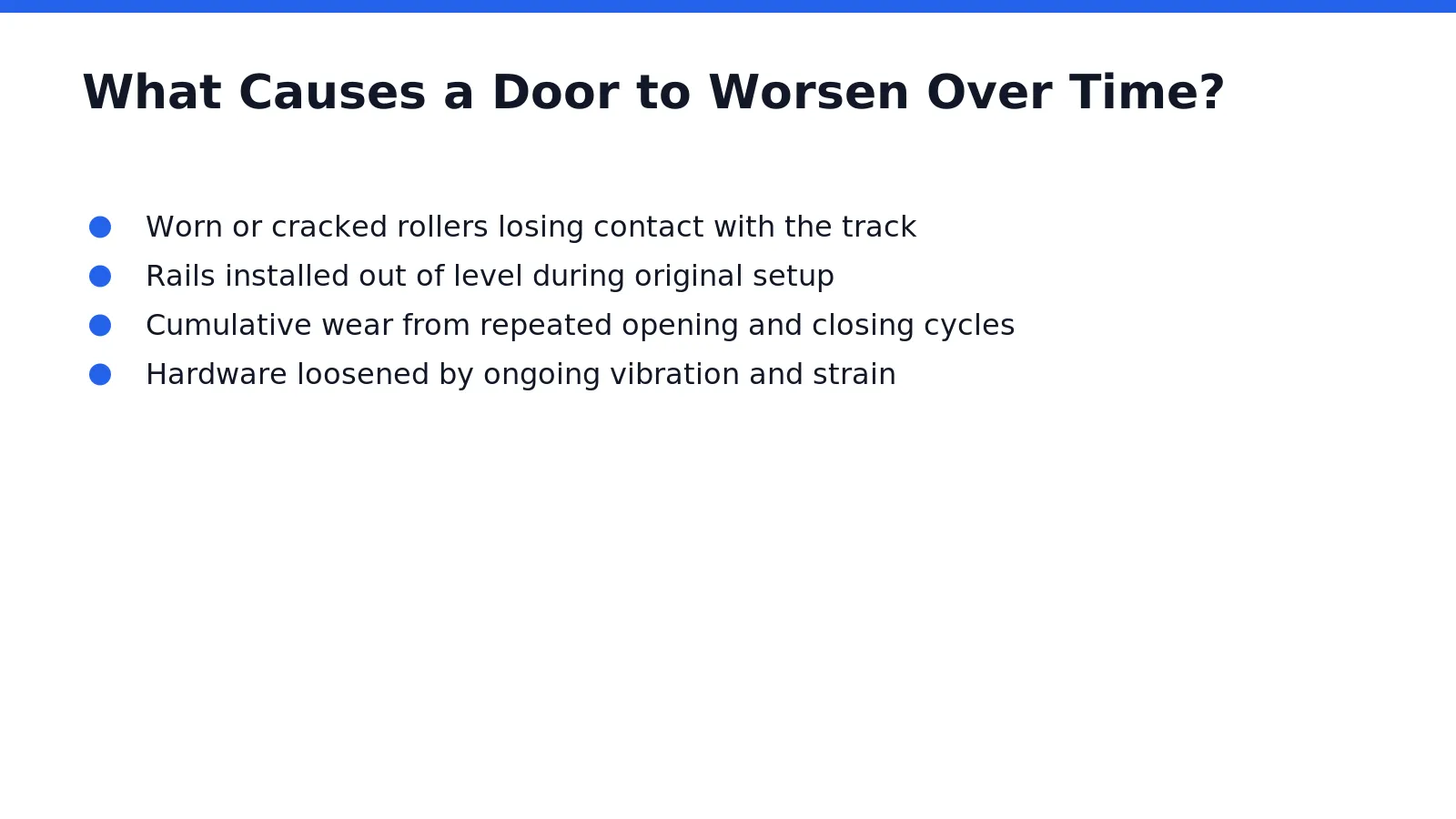
What Causes a Door to Worsen Over Time?
Small misalignments rarely stay small. A crooked garage door usually starts with one worn part. Snowballs into a system-wide problem as the door keeps cycling through its daily routine.
Worn or damaged rollers rank among the most frequent culprits. Once a roller wears down or slips off its track, the door begins to bind or drift to one side with each use. That drift often shows up first as a garage door opens unevenly, a symptom before it becomes visible from across the driveway.
Installation quality matters just as much as part condition. Vertical rails that weren’t set straight. Level from the start creates a slow, steady lean toward one side of the opening. This kind of structural misalignment doesn’t announce itself immediately; it builds gradually, cycle after cycle.
Why does a door that worked fine suddenly start lifting crooked?
Even a door that tracked perfectly at installation can start lifting unevenly after a few dozen open-and-close cycles. Repeated motion stresses rollers, rails, and hardware, exposing weaknesses that weren’t obvious at first. One corner may begin creeping closer to its rail while the opposite corner pulls in the other direction.
What makes these issues worse the longer they go unaddressed?
Ignoring early signs lets the imbalance compound. A roller that’s slightly off-track forces the opener to work harder, which accelerates wear on cables, hinges, and the rail system itself.
Common contributors include:
- Worn or cracked rollers losing contact with the track
- Rails installed out of level during original setup
- Cumulative wear from repeated opening and closing cycles
- Hardware loosened by ongoing vibration and strain
Addressing these factors early protects the door from more extensive garage door repair down the road.
Is a Crooked Door Actually Dangerous?
Yes, a crooked garage door creates genuine safety and security risks for a household, not just an unattractive view from the driveway. Homeowners often dismiss the tilt as a minor cosmetic flaw. That assumption carries real consequences.
Left unaddressed, the misalignment tends to worsen over time. What starts as a slight lean can progress toward compromised structural integrity in the door itself. Worse, a gap forms on one side of the frame, and that gap becomes an opening vulnerable to break-ins.
The mechanical risks run deeper than appearance alone. Garage doors rely on components installed under significant tension. Any error in that setup turns a routine repair into a hazard.
What Happens If Components Are Installed Incorrectly?
Improperly installed or adjusted hardware can cause the entire door to collapse without warning. A door that suddenly drops poses a serious injury risk to anyone standing nearby, including children or pets in the garage. This is one reason garage door repair work on load-bearing parts calls for trained hands, not a weekend fix.
Can a Broken Spring Really Hurt Someone?
A torsion spring under tension stores enormous force, and when it snaps, that force releases instantly. Anyone standing close to the door when the spring fails risks serious physical harm.
Because a garage door opens unevenly when one side loses tension or support, the imbalance often signals an ongoing spring or cable problem. The following issues commonly accompany a crooked door:
- Uneven spring tension on one side of the header
- Frayed or slipping cables
- Misaligned tracks pulling the panel off-center
Each points to a system that no longer carries weight safely. Each deserves prompt attention before the door fails entirely.
Can I Fix It Myself With Basic Tools?
Basic tools handle some minor fixes. A crooked garage door usually signals a bigger structural problem best left to trained hands. Homeowners with a small toolkit can address minor squeaks, loose hardware, or small roller issues without waiting on a service call. Doing these simple fixes properly, though, still requires having the right basic tools on hand before starting any project.
Mallets and locking pliers rank among the most useful tools for handling small roller or wheel problems. A mallet gently taps a roller back into its track, while locking pliers hold tension steady on cables or hardware during small adjustments. Keeping these two items in a garage toolbox saves homeowners both time and money. Minor issues won’t always require calling a professional.
When should a homeowner call a professional instead?
A crooked or unevenly lifting door often points to worn cables, misaligned tracks, or spring tension problems, not something a mallet fixes. Garage door components carry serious weight, and attempting garage door repair without proper training or certification creates a real risk of injury or further damage. If the garage door opens unevenly after a basic adjustment, that’s the signal to stop and call in a technician.
What tools belong in a basic garage door toolkit?
A short list covers most minor fixes:
- Mallet for tapping rollers back into alignment
- Locking pliers for holding tension during small adjustments
- Work gloves for handling hardware safely
- A flashlight for inspecting tracks and rollers
Beyond these simple tasks, spring replacement, cable repair, and track realignment call for a professional technician’s training and equipment.
When Should You Call a Professional?
A professional call makes sense the moment one corner of the door sits higher than the other, or the panel leans inside its opening. That kind of imbalance signals something in the system has let go, whether a cable, spring, or track component. Homeowners rarely have the tools or training to diagnose which one safely. Waiting rarely helps; a crooked garage door puts uneven strain on the remaining hardware with every cycle.
Is it safe to fix a crooked garage door myself?
Attempting a do-it-yourself fix on a misaligned door carries real physical and financial risk. Garage door systems store significant spring tension, and a mistake made while adjusting cables or tracks can cause injury. Beyond safety, a botched repair attempt can void the door’s manufacturer warranty entirely, leaving homeowners without coverage for future issues.
What happens if a DIY repair goes wrong?
A failed self-repair often means paying twice: once for the original problem, and again to fix whatever damage the attempt caused. What started as a simple adjustment can turn into a larger, costlier repair job.
Homeowners in Orange County facing a door that leans, sticks, or shows a garage door opens unevenly pattern should watch for a few warning signs before reaching for tools:
- Visible gap difference between the left and right sides at the bottom of the door
- Grinding, popping, or straining sounds during operation
- One track appearing pulled away from the wall
- Door hesitating or reversing mid-cycle
Any of these point toward professional garage door repair rather than a weekend project. Precision Door of Orange County, based in Anaheim, CA, serves homeowners throughout the county with trained technicians equipped to diagnose alignment problems safely and correctly the first time.